But is it still art then?
Ambiguous alter egos of the artist Dirk Dietrich Hennig
expose the overestimation of institutions at an exhibition
in the Sprengel Museum Hannover.
By Bettina Maria Brosowsky in: Taz, 2023
Translated by Seth Widman
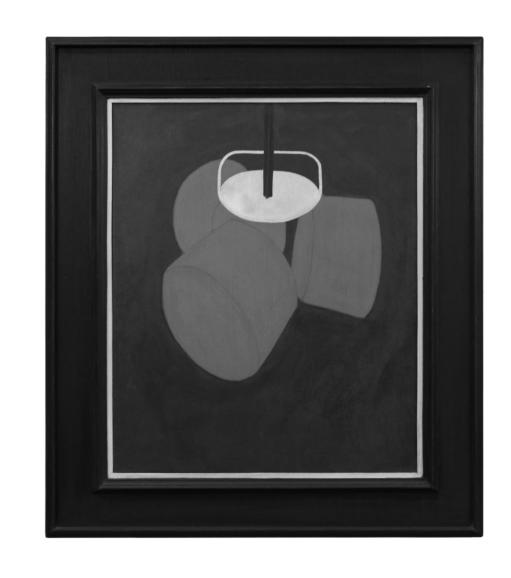
D.D. Hennig is C.G. Rudolf, who is also sometimes Marcel Duchamp,
represented here with "Étude pour la Broyeusede Chocolat no. 2." 1914/
n.a./2016 Photo: Sprengel Museum 2022
Many are certainly familiar with the Zurich-based artist duo Peter
Fischli and David Weiss. But who are George Cup & Steve Elliot? A
good ten years older than their Swiss colleagues, the two sons of
German emigrant families were supposedly part of the US avant-
garde of the 1960s. Their artistic spectrum encompassed everything
from painting to experimental film, all of which could be interpreted as
geometric abstraction. Their works, often characterized by large,
monochrome black "fades," found their way into renowned collections
and belonged to the US canon of Minimal Art—until Steve Elliot died a
violent death in 1986. George Cup was quickly convicted of murdering
his partner, and their work was subsequently ostracized,
systematically removed from collections and storage facilities, and
destroyed. Only after Cup's rehabilitation and his death in 2008 did a
reassessment begin. Tate Modern and the Centre Pompidou finally
restored the duo to their rightful place in the contemporary art world
through exhibitions of works from their estate.
This story is too good to be true. It is, in fact, one of the "historical
interventions" that the conceptual artist Dirk Dietrich Hennig, born in
1967 and now living in Hanover, has been using since his studies at
the Münster Academy of Fine Arts. He invented the American artist
couple—and apparently tragic lovers—in 2007 during a year-long stay
in New York.
Cup & Elliot are just two figures in a whole series of fictional male
protagonists created by Hennig. The exhibition ranges from the
historical fantasy of the Münster merchant Hinrich von Hagen
(1482–1534) and his rediscovered personal treasure to the German-
German fate of the historian and art forger Carl Gerhard Rudolf, born
in Erfurt in 1922 and died in Venice in 2012. Hennig slips into each
role as both performer and interpreter, lending further credibility to
them with documents, photographs, and newspaper clippings.
Hennig has recently curated an exhibition at the Sprengel Museum
Hannover that is as intelligent and coherent as it is virtuosic in the
quality of its artistic exhibits, focusing on the life, work, and collection
of C. G. Rudolf. According to the exhibition, Rudolf worked at the
Institute for History of the Academy of Sciences in Berlin, the capital
of the GDR. He came under the scrutiny of the Ministry for State
Security (Stasi) and was accused of espionage.
To evade prosecution, he agreed to forge works of art from
classical and contemporary modernism to obtain foreign currency
within the framework of the real-world Commercial Coordination
(KoKo) department of the Ministry for Foreign and Intra-German
Trade in East Berlin. Using only simple reproductions, the self-taught
artist Rudolf created true masterpieces over a period of 20 years:
paintings by Duchamp, Picasso, and Mondrian; reliefs by Arp and
Schwitters; and veritable object art such as Christo's "Wrapped Toy
Horse" from 1965 or the two-part study "Toilet" and "Sink-Hard
Model," created from painted cardboard by Claes Oldenburg in 1966.
However, Rudolf did not simply imitate well-known works. In the
style of the media-famous "forger of the century," Wolfgang Betracchi,
he created newly discovered, previously unknown works that
coherently "expanded" the oeuvre of the respective artists. In his
theoretical writings, Rudolf also reflected on the phenomenon of a
work of art's aura, which, according to Walter Benjamin, is bound to a
collectively sanctioned original. Rudolf broadened the concept to
include an aura "projected" by the recipients, a kind of substitute for
religion, which he empirically demonstrated using works he had
created.
But what, then, is art? What values do we worship when we visit an
exhibition or a museum? D. D. Hennig and his alter ego C. G. Rudolf
cleverly expose the intellectual overestimation of institutions that they
alone are entitled to "make" our art history.
"The Rudolf Collection": Dirk Dietrich Hennig, Sprengel Museum
Hannover, until January 8, 2024
© dirkdietrichhennig.com 2025