Failure as a Historiographical
Category
On Dirk Dietrich Hennig's Historical Intervention as
Artistic Practice
by Henry-Pierre Bertin
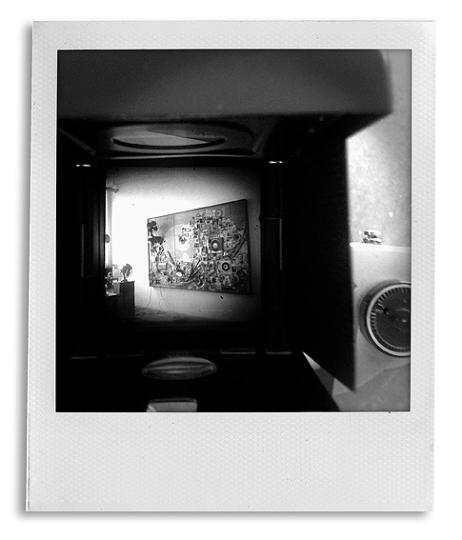
Project: Jean Guillaume Ferrée, La Grande Vague de Kanagawa, 1970, Courtesy : IKOB
Musée d'Art Contemporain de Belgique.
“History is a malleable mass, and I wanted to deform it.”
— Dirk Dietrich Hennig, Kunstforum International, Vol. 252, 2018
I. The Archive and Its Constructedness
Every archive is a monument to forgetting. What enters the canonical
record of art history is never simply what existed, but rather what was
seen, named, and preserved by those who possessed the institutional
authority to do so. The rest—the overlooked, the temporally
misplaced, the geographically peripheral, the structurally
inconvenient—disappears. Not destroyed, but tacitly declared non-
existence.
Dirk Dietrich Hennig, born in Herford in 1967, studied sculpture at the
Münster Academy of Fine Arts. Since 1998, when he founded the
Institute for Historical Intervention, he has developed an artistic
method he calls "historical intervention": the retrospective intervention
in art history by implanting fictitious artists' names into the existing
canon without explicitly acknowledging their fictional nature. He rarely
appears as the author of his own works; he assumes the role of
mediator, curator, archivist, and executor of artists' estates, helping
forgotten gain visibility.
In an interview with Sabine Maria Schmidt, he explains the driving
force behind his practice with astonishing brevity: "History is a
malleable mass, and I wanted to deform it." This statement is
programmatic. It names not only a method but also a fundamental
epistemological stance: Art history is not a neutral record of past
events but a construct—and thus, in principle, malleable, open to
attack, and expandable. Hennig's work is the logical artistic
consequence of this insight.
II. Fake and Forgery: A Necessary Distinction
Before the theoretical coordinates of Hennig's practice can be
defined, a terminological clarification is indispensable, one that art
theorist Stefan Römer has fundamentally undertaken: the difference
between fraudulent forgery and artistic fake. Forgery is designed to be
concealed—it is not meant to be discovered. Artistic fake, on the other
hand, as Hubertus Butin specifies in his analysis of Hennig's practice,
is designed to reveal itself: one is initially deceived, but—as with
trompe-l'œil—is meant to see through the deception after some time
and reflect upon it.
This distinction is fundamental to understanding Hennig's work. As
Butin emphasizes, Hennig does not—like other producers of fake art
or representatives of Appropriation Art—simply produce forged
artworks. He delivers a comprehensive fictional history: exhibition
catalogs with reproduced works, old newspaper and magazine
articles, photographs, films, letters, official documents, and obituaries.
These biographical documents are cleverly interwoven with the
names of real artists, collectors, gallery owners, critics, and museum
curators. In historical photographs, Hennig even has his protagonists
appear alongside supposed contemporaries: In a manipulated photo
from 1962, for example, Andy Warhol and George Cup are seen
engaged in lively conversation at a party.
The exposure is implied, but discreetly delayed. The imprint of the
Wolfenbüttel catalog for George Cup & Steve Elliott contains the line:
"Copyright 2023 Dirk Dietrich Hennig"—a discrepancy that alerts
attentive readers that something is amiss with the claimed authorship.
Elsewhere, for example at the Sprengel Museum, the deception was
explicitly acknowledged in the catalog text. These different degrees of
explicitness are themselves part of the artistic dramaturgy.
III. The Logic of the Collection
and the Production of Significance
In his Logic of the Collection (1997), Boris Groys formulated one of
the most incisive institutional critiques of modernity: A work of art is
not considered historically significant because it is significant, but
because it fits the institutional logic of the museum collection. The
museum generates significance through the act of acquisition—it
does not represent it. The collection is not the record of art-historical
relevance, but its condition. Groys distinguishes between the profane
space of everyday life and the sacred space of the archive: The
transition between the two does not occur according to aesthetic
criteria alone, but according to an internal logic of institutional
difference—the value of innovation: The new must be foreign enough
to count and familiar enough to be acquired.
In this light, Hennig's practice can be read as a consistent empirical
verification of this thesis. His fictional artist figures are constructed
with precisely the institutional fit that Groys describes: formally
coherent, biographically plausible, and art-historically relevant. The
result is documented: works that Hennig created under the names of
his invented characters were acquired by the Bundeskunstsammlung
Bonn, the Sprengel Museum Hannover, and the ikob Museum für
zeitgenössische Kunst in Eupen. The museum doesn't recognize what
it's acquiring—it only recognizes whether the form of acquisition
conforms to its own conventions.
In his later work In the Flow (2016), Groys radicalizes this finding
under the conditions of the digital present: contemporary art no longer
produces objects, but rather events and their documentation. The
archive is no longer the aftermath of art, but its primary form of being.
Hennig grasped this logic earlier than most. His fictional characters
exist primarily as a flow of documentation—and are therefore
indistinguishable from legitimate historical figures in the digital age. In
an interview with Kunstforum, he puts it pragmatically: "The footnote
is the true space of revolution." The archival detail, not the work itself,
creates reality.
IV. The Legend of the Artist
and the Normativity of Biography
In 1934, Ernst Kris and Otto Kurz published their study The Legend of
the Artist, one of the most consequential investigations into art
biography ever undertaken. Their central thesis: The biographies of
artists that have been handed down are not neutral accounts, but
rather prefabricated literary narratives. Kris and Kurz identified
recurring topoi—the child prodigy, the darling of the gods, the social
outcast, the life between Parnassus and the bohemian—that run
through art biography from antiquity to the modern era, regardless of
whether the respective sources stand up to scrutiny. Both biographers
and the artists themselves participate in the production of these
clichés: Biographers draw on literary models, and artists idealize their
own life stories according to the same pattern.
The result is a normative image of the artist that remains stable for
centuries and determines inclusion in the canon: Those who fulfill the
cliché are remembered. Those who don't meet the criteria are
excluded. Hennig's fictional artist figures are, without exception, anti-
legends—negative imprints of the normative cliché. As will be shown
below with regard to these figures, this is not accidental, but rather a
deliberate concept.
A Topography of Failure
Jean Guillaume Ferrée (1926–1974), the German-French artist from
Alsace who worked in the Fluxus idiom, did not consider himself an
artist due to a pathological illness. He failed at self-realization: he did
not fulfill the topos of artistic self-knowledge, without which no entry
into the canon was possible.
George Cup & Steve Elliott, celebrated in New York as precursors of
American Minimal Art—Hennig constructed for these figures the
image of a homosexual artist couple, emotional and rational,
networked with famous artists, and collected by renowned
museums—were erased from art historical consciousness as a result
of a murder. Their failure stems from a biographical stigma: the
normative narrative of the artist permits moral transgressions only in
certain, romanticized forms.
Gustav Szathmáry (1867–1907), the Hungarian composer,
photographer, and camera inventor, fails due to his geographical and
temporal periphery: too early, in the wrong place, in the wrong
language. The canon, as Hennig demonstrates, is a Eurocentric and
metropolitan distorted construct.
Carl Gerhardt Rudolf ultimately fails due to political
instrumentalization: the topos of the autonomous artistic
personality—described by Kris and Kurz as constitutive of the
legend—was denied him. His work is the work of another's will. This
case deserves closer examination.
V. The Rudolf Case: Forgeries by a Forged Forger
The project The Rudolf Case: How Modernism Was Forged on Behalf
of the KoKo is perhaps Hennig's most sophisticated and conceptually
complex work. It was first presented in 2016 at the Villa Rosenthal in
Jena and shown in an expanded version at the Sprengel Museum
Hannover in 2022.
Here, Hennig invents a fictitious forger: Carl Gerhardt Rudolf
(1922–2012), a historian with a degree in history, working at the
Institute for History of the German Academy of Sciences in East
Berlin, transferred in the fall of 1966 to the college of the Ministry for
State Security in Potsdam, and arrested in 1967 on the pretext of
espionage. As an unofficial collaborator with the codename IM
Rembrandt, Rudolf worked for the Modern Art (MoK) division of the
Commercial Coordination (KoKo) under Alexander Schalck-
Golodkowski from the mid-1960s onward—the foreign currency
procurement organization responsible for the systematic export of
artworks in East Germany.
The historical context in which Hennig places this character is real
and meticulously researched: The Art and Antiques GmbH, founded in
1973, did indeed organize the sell-off of East Germany's private and
national art collections. Manfred Bachmann, then Director General of
the Dresden State Art Collections, spoke of an alarming loss of assets
as early as 1974. Besides the codename Rembrandt, the KoKo files
also contain the codenames van Eyk, Pikasso, and Rubens. Hennig
implants the fictional character of Rudolf into this real structural
framework with a conviction grounded in meticulous archival
research.
The theoretical basis for Rudolf's criminal career is particularly
ingenious: Rudolf, a self-taught scholar, had based his private
research on Benjamin's essay on the work of art and conducted
experiments on "aura duplication." Starting from the premise that the
aura is a form of projection of the viewer onto the artwork, he began
copying artworks to determine whether he could transfer the
experiential value of the original to the duplicate. Hennig has Rudolf
write in 1965: "If the aura is not inherent in the artwork but is projected
onto the work by the viewer, then the artwork is a projection surface
for the need for meaning and contemplation." According to the
constructed narrative, this research was reported to the Stasi by an
informant and led to Rudolf's forced recruitment.
Hubertus Butin succinctly formulated the crucial conceptual point of
the project: Hennig forged the forgeries of a fictitious forger. This
intricately constructed work reaches a new level of reflexivity: not only
is the figure invented, but so are the crimes attributed to it. The
question of original and copy, of authenticity and forgery, is driven into
a recursive loop from which there is no conceptually stable escape.
Among the exhibited artifacts, besides the "forged forgeries"—works
after Mondrian, Schwitters, and Duchamp—were a fabricated Zeit
magazine interview with Rudolf, as well as Stasi documents: a 1967
notification of receipt and a 1966 transcript of a conversation about
the informant candidate "Rembrandt." Hubertus Butin describes the
viewer's moment of discovery: only the discovery of several spelling
errors in the fabricated newspaper texts made the fake obvious.
Rudolf, according to Hennig in the Kunstforum interview, operates on
the level of "alternative facts": "Yes, absolutely. Truth is constructed
through context and consensus."
Viewed in Groys' terminology from In the Flow, the Rudolf project is
the most consistent realization of the thesis that the archive has
become the primary reality of art: the Stasi documents, the
newspaper articles, the exhibition information materials—they are all
events that exist solely as a flow of documentation. And because this
also applies to all historically legitimate art archives, the boundary
between Hennig's construction and historical reality is structurally
undecidable.
VI. Wyss, Hegel, and Productive Failure
The philosophical depth of Hennig's entire project unfolds in dialogue
with Beat Wyss's Mourning of Completion (1985). There, Wyss traces
a genealogy of modern cultural criticism that originates with Hegel's
lectures on aesthetics. Wyss reads Hegel's thesis of art's past-
oriented character—that art has passed its highest calling, that
thought and reflection have surpassed art—not as a death sentence,
but as the birth of cultural criticism itself. The mourning of completion
is productive: the awareness that art fails to meet an absolute
standard is what first generates the modern concept of art and, with it,
art history as a discipline. The archive, the museum, the catalog, the
critical essay—all these institutions arise because art is always
already incomplete, because it always falls short of what it should be.
What distinguishes Hennig's practice in this light is the radical way in
which he artistically transforms Wyss's diagnosis. His fictional
characters do not fail due to aesthetic inadequacy—their works, as
the acquisitions in the collection demonstrate, are formally convincing
enough to gain institutional acceptance. They fail because of the
normativity of art biography (Kris/Kurz), the institutional selectivity of
the archive (Groys), and that constitutive incompleteness which Wyss
describes as a structural feature of art history.
In this, Hennig makes a crucial shift from Wyss: For Wyss/Hegel, art
fails because of completion as a philosophical category. For Hennig,
art history fails because of its own constructedness—and he makes
this failure visible by falsifying it. The grief over completion is not a
philosophical necessity, but a narrative decision. Whoever writes the
record decides who has failed and who has not. Hennig writes the
record—retrospectively.
VII. Parafiction, Rediscovery,
and the Economics of the Art World
The art-theoretical classification of this practice owes much to Carrie
Lambert-Beatty's concept of parafiction (October 2009): artistic works
that operate in the gray area between fact and fiction without
completely resolving this tension. Parafictions are neither lies nor
fictions made transparent. They activate the credibility mechanisms of
their context—and in doing so, expose its structure.
However, Hennig transcends Lambert-Beatty's framework in one
crucial respect: his interventions are not media-critical but archival-
historiographical. They become part of the permanent collection. For
example, a film by George Cup & Steve Elliott was included in the
cinema program of the exhibition The Heritage of De Stijl at Tate
Modern in London in 2010, without the curators in charge recognizing
its fictional nature. The following year, the same work appeared in the
Mondrian and De Stijl film program at the Centre Georges Pompidou
in Paris. In an interview with Kunstforum, Hennig explains the
mechanics of the process: “Yes, but not to me, rather to the George
Cup Research Center, based in Hanover and New York. I therefore
decided to remain in the role of providing all the materials. However,
they weren't properly read, let alone examined; otherwise, my
authorship would have been evident from the materials.”
This finding fits into an economic analysis of the art world, which
Hennig clearly articulates in the interview: “Art history functions like a
very coarse fishing net; naturally, a lot falls through, much of it
unjustly.” Hubertus Butin explains that Hennig's fakes found
particularly fertile ground in the first two decades of the 21st century
by pointing to the concurrent trend, driven by the art world, of
rediscovering overlooked artists—Bill Bollinger, Getã Brătescu,
Carmen Herrera, Channa Horwitz, Lee Lozano, Alina Szapocznikow.
The art world loved such stories, as historically overlooked figures
could generate hype in exhibitions and the art market. Hennig
consciously played on this logic of expectation: "Nevertheless, I also
play with these market mechanisms, where forgotten and overlooked
artists are regularly unearthed and rediscovered."
VIII. Art Historical Coordinates and Precursors
Hennig's practice is inconceivable without its art historical
preconditions. The most direct genealogical connection leads to
Marcel Broodthaers's Musée d’Art Moderne, Département des Aigles
(1968–1972): a fictitious museum with its own collecting logic and
curatorial rhetoric. Broodthaers emptied the museum to make its
institutional conventions visible. Hennig reverses this gesture: he fills
the archive to expose its selective logic.
A direct conceptual precursor is the figure of Hank Herron, invented
by art theorist Carol Duncan in 1973 in Gregory Battcock's anthology
Idea Art under the pseudonym Cheryl Bernstein: a critique of a non-
existent artist. Duncan's fake remained undetected for 13 years until
Thomas Crow revealed the secret. As Butin emphasizes, the crucial
difference between Duncan and Hennig lies in the material execution:
Duncan merely imagined and described Hank Herron's works, while
Hennig actually produced both the works themselves and the entire
biographical documentation.
The deepest intellectual affinity lies with Walter Benjamin's conception
of the historian as the savior of forgotten possibilities. In his Theses
on History (1940), Benjamin describes historical thinking as a rescue
project for the defeated, the failed, those who have fallen out of the
continuum of history. Hennig's fictional artists are Benjaminian figures:
they embody the unrealized potential of art history. With one crucial
difference: Hennig invents them. And in this invention, he reveals that
Benjamin's act of rescue was itself always a construct.
IX. The Virtuality of Authorship
One final dimension of Hennig's practice demands attention: its
relationship to authorship. In art historical terms, Hennig is the author
of all these works. Within his own project logic, however, he
consistently erases this authorship. He does not appear as Dirk
Dietrich Hennig, artist, but as discoverer, archivist, curator of other
people's forgotten legacies. In an interview with Kunstforum, he
explains this stance: "I like my invisibility behind my work. I'm not
concerned with balancing the boundaries of forgery or exposure, but
rather with creating something new."
Hennig does not romanticize his own invisibility. He precisely names
its paradox: In the 2011 publication Encyclopedia of Fictional Artists
(Koen Brams / Krijs Gruijthuijsen), he is not listed as an artist, but as
the originator of his invented artists. Museums and curators
sometimes worry about the credibility of their institution when they
exhibit his work. This anxiety, one could argue, is the work itself. It
names precisely the institutional fragility that Hennig wants to make
visible.
In historical photographs, Hennig embodies his own figures—he is
George Cup in the manipulated Warhol photograph, he is Rudolf at
the easel in the Zeit magazine. This embodiment is thus not merely a
documentary strategy, but a form of self-annihilation: the author
disappears into the figure. Groys' observation from In the Flow, that
digital art produces aura without an object, finds its most pointed
artistic formulation here: Hennig produces authorship without an
author.
Coda: In Situ
Dirk Dietrich Hennig lives and works, as his own biographical notes
laconically record, “in situ.” The term is a gesture: situ denotes the
place one actually occupies, the concrete coordinates of the present.
Working in situ means working in the world as it is — not as it should
be.
The world as it is encompasses an art-historical protocol that has
always been selective, constructed, and shaped by power relations. It
encompasses an art biography based on normative clichés that
exclude those who do not conform to them. It encompasses an
institutional logic that generates meaning rather than depicting it. And
it encompasses a market that uses the rediscovery of the forgotten as
a value-creation strategy.
Into this world, Hennig places his meticulously crafted ghosts —
Ferrée, Szathmáry, Cup & Elliott, Rudolf, and the others — not to
deceive, but to pose a question that art history is reluctant to answer:
If these figures fit into the logic of the collection, into the structures of
the archive, into the topoi of the artist legend — if the museum, the
institute, and the curator accept them — what does that say about
those who were once rejected under the same conditions? History,
according to Hennig, is malleable. He has deformed it. And in
deforming it, he has shown how malleable it has always been.
Selected Literature
Hubertus Butin, Kunstfälschung. Das betrügliche Objekt der Begierde, Berlin 2020.
Boris Groys, Logik der Sammlung. Das Ende des musealen Zeitalters, München/Wien 1997.
Boris Groys, In the Flow, London/New York 2016.
Dirk Dietrich Hennig, Der Fall Rudolf. Wie die Moderne im Auftrag der KoKo gefälscht wurde.
Ausstellungsinformation Villa Rosenthal, Jena 2016.
Ernst Kris / Otto Kurz, Die Legende vom Künstler. Ein geschichtlicher Versuch, Frankfurt am Main
1980 [1934].
Carrie Lambert-Beatty, „Make-Believe: Parafiction and Plausibility“, in: October, Bd. 129, 2009.
Naoko Kaltschmidt, „Dirk Dietrich Hennig“, in: Springerin, Heft 1/2009.
Stefan Römer, Künstlerischer Fake. Zur reflexiven Figuration von Original und Fälschung in der
Avantgarde, München 2001.
Sabine Maria Schmidt, „Moderne, reloaded: Interviews mit Künstlern — Dirk Dietrich Hennig:
Geschichtsinterventionen“, in: Kunstforum International, Bd. 252, 2018, S. 164ff.
Walter Benjamin, „Über den Begriff der Geschichte“ (1940), in: Gesammelte Schriften, Bd. I.2,
Frankfurt am Main 1974.
Beat Wyss, Trauer der Vollendung. Zur Entstehung des Kulturkritikers, München 1985.
Hubertus Butin / Stephanie Rosenthal (Hg.), Frau Hollmann im Gespräch mit Dirk Dietrich Hennig,
Kunstverein Wolfenbüttel, 17. Dezember 2023 [Manuskript].
Ulrich Krempel / Stiftung Niedersachsen (Hg.), Dirk Dietrich Hennig, Göttingen 2022.
© dirkdietrichhennig.com 2026